Phone Protection
Find out when your phone number moves to someone else
Email, bank, brokerage, the wire instructions on your closing. They all fall back to a code sent to your phone. FendLand checks your number every day for the carrier changes that mean somebody else is now receiving those codes.
Included with Shield Pro.
Why a phone number gets stolen
Most of your accounts will let someone in if they can receive one text sent to your number. Whoever controls the number can reset the password on your email, and through the email, everything else.
For a property owner the exposure is worse in one specific way. The details a carrier asks for to verify you (full name, current address, phone number) are the same three fields a data broker sells together in one row, and your deed has already put two of them on public record.
If you are in the middle of a sale or purchase, the same number is also how your title company reaches you about the wire.
The takeover, and where the alert lands
Without monitoring, step four is the first thing you notice, and by then the account resets have already run.
- 1
They buy your details
Name, address and phone, sold together by the same brokers that scrape property records.
- 2
They call your carrier as you
A port request to another carrier, or a SIM swap at the same one. Support has no way to know it is not you.
- 3
Your number moves
Calls and texts now arrive on their device. Your phone usually just shows no signal, which is easy to miss for hours.
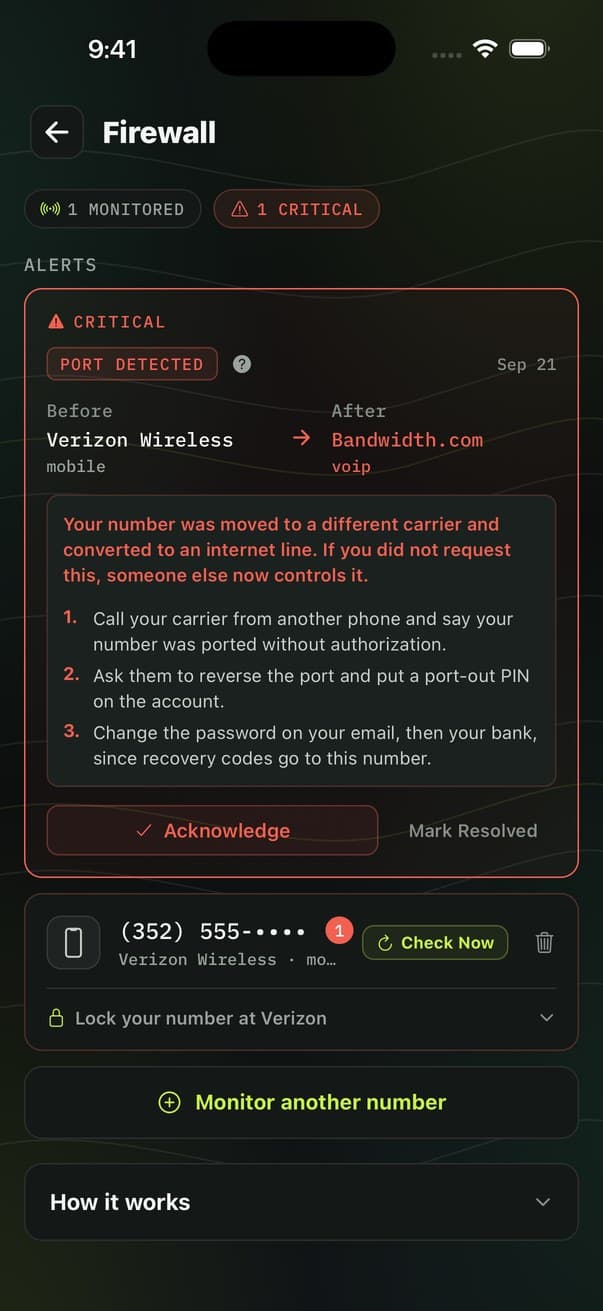
The alert lands here, after step three
The daily check sees the carrier and line type both change, which is the port-out signature, and pushes a critical alert with the three calls to make first. Normally that is the same day, while your carrier can still reverse the port. The sooner you call, the fewer resets have run.
- 4
The resets begin
Email first, because every other account recovers through it. Then anything holding money.
The five changes FendLand alerts on
Enrolling records a snapshot of your number. Every check compares live carrier data against it, and each difference means something different.
Port detected
Carrier and line type both moved at once. This is the classic takeover signature and it is always treated as critical.
SIM swap detected
The SIM change date is new while carrier and line type look identical. A carrier comparison alone would never see this one.
Carrier changed
The network behind your number changed on its own. Legitimate if you switched, worth a look if you did not.
Line type changed
A mobile line became VoIP, or the reverse. Attackers often convert a line during a takeover.
Caller ID name changed
The name registered to your number was altered. Usually harmless, occasionally the first sign of tampering.
What monitoring can and cannot do
FendLand cannot stop a port-out. It has no relationship with your carrier and no way to refuse a transfer request. What monitoring gives you is an earlier warning, and a hijacked number is easier to get back the sooner you call your carrier.
The control that prevents one is a port-out PIN or number lock on your carrier account. It is free, it takes about five minutes, and every major carrier offers it. The app shows the steps for your carrier directly under your monitored number, because setting the lock does more than watching for a port-out.
Monitoring is the backstop for the case where the lock was not set in time, or where someone talked their way past it anyway.
Removing the details a takeover starts from
A takeover starts with someone buying the details that let them impersonate you. Fewer listings means a thinner file to work from.
- Exposure CheckFree, no accountSee which brokers are publishing the name, address and phone combination a carrier would ask you for.
- Removal CenterFree and Pro tiersRemove your info yourself, step by step, or let Shield Pro remove it for you at most sites and re-check every 90 days.
- Wire Fraud ProtectionShield ProMid-closing? Forward any email about the wire and FendLand checks it for the signs of a redirected payment.
What people ask about number monitoring
Can FendLand stop a port-out from happening?
No, and you should be wary of anything that claims it can. FendLand has no relationship with your carrier and cannot refuse a transfer request. What it does is notice that one happened, normally within a day, so you can call your carrier while it is still reversible. The thing that prevents a port-out is a port-out PIN or number lock on your carrier account, which the app walks you through setting.
What is a port-out attack?
Someone collects enough of your personal details, often from the same data brokers that leak your property records, then contacts your carrier posing as you and transfers your number to a different carrier or an internet calling service. Once it completes, your calls and texts go to them, including password reset codes.
How is a SIM swap different?
A SIM swap keeps your number at the same carrier but moves it to a new SIM card. Carrier and line type both look unchanged, which is why a simple carrier comparison misses it. FendLand checks the SIM change date separately for that reason.
How quickly would I find out?
Your number is checked daily, so the normal case is same-day. That matters because the window where a carrier will reverse an unauthorized port without a fight is measured in days, and most people only discover it when their phone stops working.
What does it check?
When you enroll, FendLand records a snapshot of your number: the carrier behind it, the line type, the registered caller ID name, and whether it has been ported. It re-reads live carrier data on a schedule and compares. A carrier and line type that both change at once is the signature of a port-out; a new SIM date with everything else unchanged is a swap.
Does FendLand need access to my phone account?
No. It never logs into your carrier account and never asks for your carrier password. It reads the public carrier routing data for the number, which is the same data any business uses to look up whether a number is a mobile or a landline.
Why would someone target my number because I own property?
Property records are public, and the brokers that compile them sell your name, address and phone together in one row. That bundle is most of what a carrier asks to verify your identity. Owning property does not make you a target on its own, but it does make the identifying details unusually easy to buy.
Set up number monitoring
Enroll your number once. FendLand snapshots it, checks it daily, and walks you through locking it at your carrier so there is less to catch in the first place.
Get FendLand