WIRE FRAUD PROTECTION
Shield ProOne email, sent days before closing, costs people everything.
It looks like your title company, it arrives exactly when you expect instructions, and the money is gone within minutes of sending. Forward any closing email to your private check address and FendLand tells you what is wrong with it before you wire.
Takes about a minute and needs a FendLand account. No mailbox access, ever.
WHY THIS ONE WORKS SO WELL
The email is expected. That is the whole trick.
Nearly every other scam has to manufacture a reason to contact you. This one does not. You are days from closing, you know wire instructions are coming, and you are waiting for exactly this message. Ordinary suspicion is switched off because the email is not out of place at all.
Whoever sends it usually knows the closing date, the property, and the name of your title company, because a real-estate transaction touches a lot of inboxes and only one of them needs to have been compromised.
And a wire is close to irreversible. Once sent it is usually moved and withdrawn within hours, which is why the only defence that has ever reliably worked happens in the minutes before you press send.
HOW IT RUNS
You forward. It answers in seconds.
01
Add your closing
Your closing date and property address. You get back a private check address that belongs only to this transaction.
02
Name who you expect
Tell FendLand the domain your closing mail comes from and save your escrow contact's real phone number.
03
Forward anything about money
Send it to your check address, or set your own mail provider to auto-forward closing mail once and forget about it.
04
Read the flag before you send
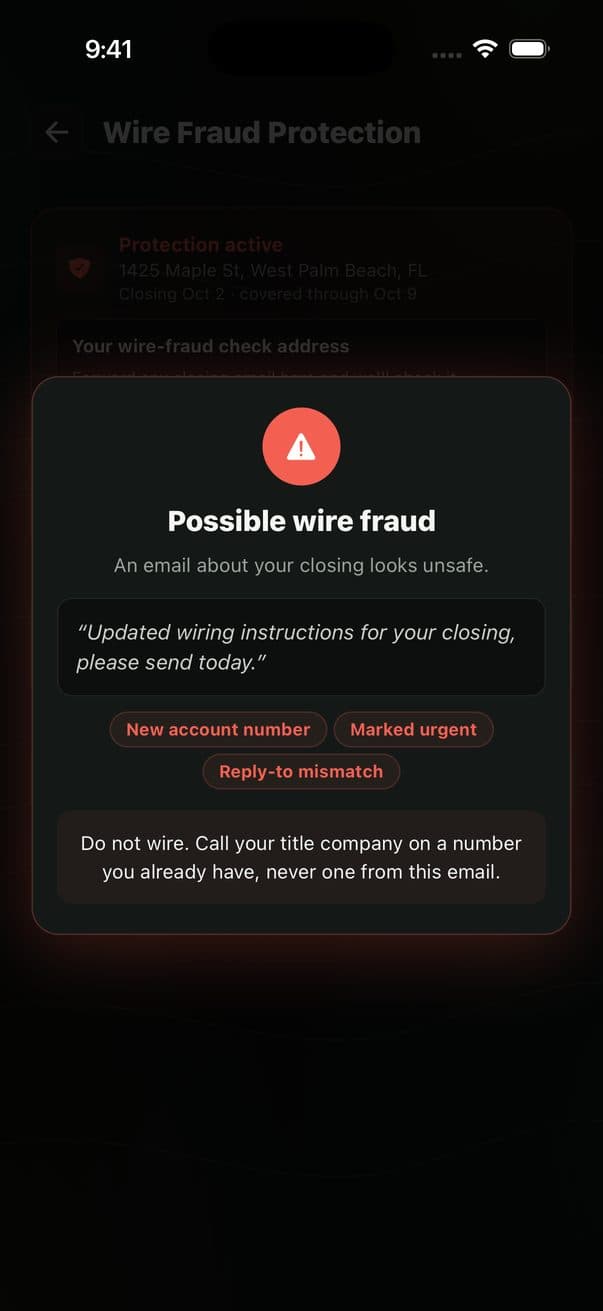
The sender, the domain, and every link are checked, and anything wrong comes back as a warning with the number to call.
READ THIS BEFORE YOU TRUST ANY OF IT
FendLand will never tell you an email is safe
It raises a flag when something is wrong and stays quiet otherwise. Quiet is not a verdict and must never be read as one. A careful fraudster can send a message that produces nothing to flag, and if a green tick existed here it would eventually be shown on exactly that email.
That asymmetry is the design. A missed flag costs you a phone call you were going to make anyway. A false all-clear costs you the wire, and a wire does not come back.
So the rule does not change: call your title or escrow contact on a number you already had, and confirm the instructions out loud, every time.
FendLand is a second pair of eyes on that call, never a replacement for it, and it is never authorization to send money.
WHAT GETS EXAMINED
Four things, and the domain is the one that matters most
The lookalike domain
acmetitle.com becomes acmetitle-closings.com, or acmetltle.com. It reads correctly at a glance, especially on a phone, and it is the mechanism behind most closing wire fraud. Name the domain you expect and near-misses get flagged.
Who actually sent it
The real sending address behind the display name, which is often nothing like the company the message appears to be from.
Where the links go
The address a link truly resolves to, rather than the text printed over it.
A known-good number to call
Save your escrow contact and it is one tap away inside the alert, so you verify on a line the email could not have chosen for you.
Where your title company is a verified FendLand partner, their real domain and phone numbers are already known, which makes a lookalike stand out immediately. That trust is granted after review, never self-asserted by whoever signs up.
WHAT WE CAN AND CANNOT SEE
No mailbox access, at any point
FendLand never connects to your email account, never asks for your password, and has no standing feed from your provider. There is no inbox being watched, because there is nothing connected to watch it with.
What exists is a private check address for your closing. Mail reaches it only because you forwarded it, or because you set your own provider to forward closing mail once. You decide what arrives, and you can stop it at your end whenever you want.
The check address belongs to that transaction. When the closing is done, so is its job.
WHERE THIS SITS
A closing is the loudest moment you will have
A transaction puts your name, address and phone into a dozen systems at once, and the exposure does not stop when it closes.
Background reading: how to avoid wire fraud at closing. Title company or lender? See the partner program.
QUESTIONS
What buyers ask before closing
Does FendLand read my email?+
No. It has no access to your mailbox and never asks for your email password. You get a private check address and you decide what reaches it, either by forwarding a message yourself or by setting your own mail provider to auto-forward closing mail once. Nothing arrives that you did not send.
Will it tell me an email is safe?+
Never, and that is deliberate. It raises a flag when something looks wrong and stays quiet otherwise, but quiet is not a verdict. A fraudster who does everything carefully may produce nothing to flag. The rule that keeps you safe is the one that has always worked: confirm wire instructions by phone, on a number you already had, before sending anything.
What does it actually check?+
The sending address and the domain behind it, whether that domain is a near-miss of one you told us to expect, the links in the message and where they really go, and the hallmarks of a redirected-wire message. Where your title company is a verified FendLand partner, their real domain and phone numbers are known, which makes a lookalike stand out immediately.
What is a lookalike domain?+
The trick behind most closing wire fraud. Your title company is acmetitle.com and the email arrives from acmetitle-closings.com, or acmetltle.com. It reads correctly at a glance, especially on a phone. Tell FendLand the domain your closing mail comes from and near-misses of it get flagged. That check only ever raises a flag; it is never used to mark a message safe.
What do I do when something is flagged?+
Do not reply to the email and do not call a number printed in it, because both lead back to whoever sent it. Call your title or escrow contact on the number you already had. If you saved that contact in FendLand it is one tap away inside the alert, which is the point: you verify on a line the email could not have chosen for you.
When should I set this up?+
As soon as you are under contract. The fraud lands in the last days before closing, when the wire is imminent and you are expecting instructions, so it needs to be running before that window rather than started once something already looks wrong.
Do I need the app?+
No. You can add your closing from the web and forward email from any mail client. The app adds push alerts, which matter here because the warning is only useful if it reaches you before you send the wire.
Check a suspicious closing email
Add your closing, get your private check address, and forward anything that mentions wire instructions. Set it up while there is still time for it to matter.
Turn on wire-fraud protection